

Finding out who owned land and property in the earliest years of the South Australian colony has been made easier than ever as legislation regarding access to land records has recently relaxed.
Applications to bring land under the Real Property Act can be viewed by the public 80 years after they were lodged with the Lands Titles Office.
It is the first time this has been possible since 1858 after changes to the Statutes Amendment (Planning, Infrastructure and Other Matters) Act 2025 (external site), which amends s42 of the Real Property Act, took effect in 2026.
As the documents reveal how a parcel of land has changed hands over time, they can be a great use to a family or local historian's research.
Landowners revealed in historic property application documents
These records document an application to bring land under the provision of the Real Property Act, 1858 (and successor Acts) and for the issue of a Certificate of Title. The Act allowed for voluntary documentary conversions of land to a Real Property Act title.
Documents held with an application show a chain of title on a parcel of land and may include a survey plan, correspondence, reports from the Title Examiners and the Survey Draftsman, draft Certificate of Title, caveats against the Application, and deeds, mortgages, and other dealings with the land.
These applications, kept in envelopes, or "packets" are archived in the State Records' collection as GRS 18635 (external site) (external site) (external site) (external site).
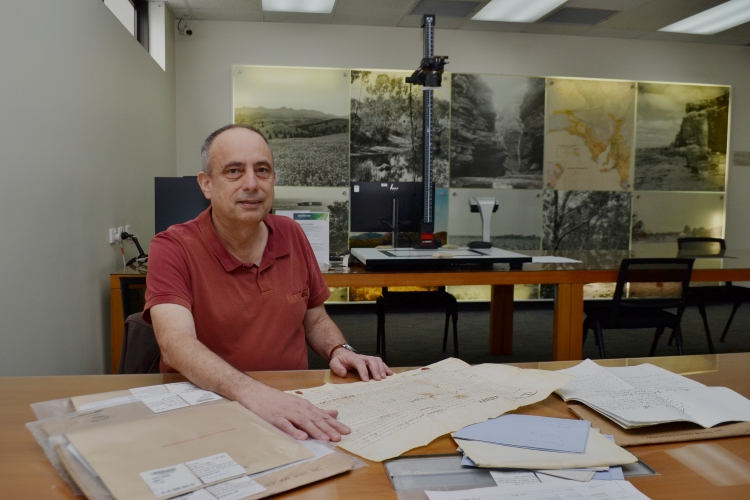
David looking through application packets at State Records' Research Centre
Access at the Research Centre
These application packets are often viewed at our Research Centre, including by David (pictured above) who was the first researcher to open up a packet after the change in legislation.
David is using the packets for his research of various hotels within the square mile of Adelaide, particularly the original public houses of the city and 'lost' hotels.
"These documents quite often supply a diagram of the land as well as tidbits of information that make for interesting reading when included as part of an overall write-up." David said.
The application packets can be viewed and photographed at State Records' Research Centre using a digital overhead camera. Visit our Research Centre appointments page to book your appointment.
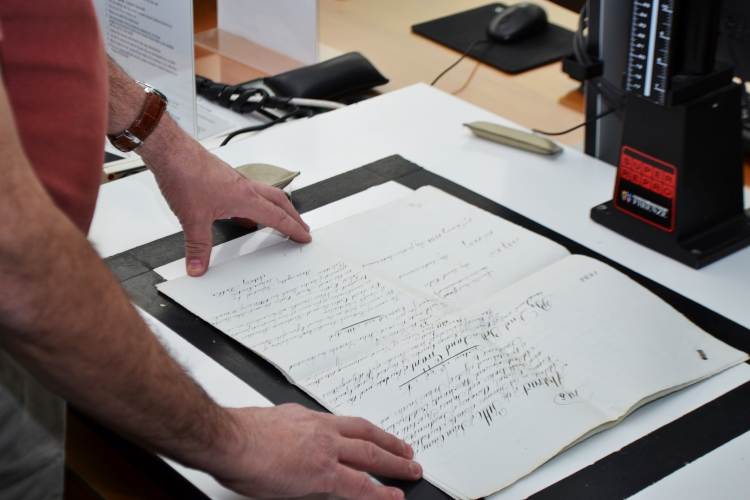
Documents from the application packets ready to be photographed using the overhead camera at State Records' Research Centre
Land application packets: A useful resource for family and local historians
Family and local historians may find looking at who owned certain pieces of land, and when, through looking at the packets, may help their research.
While other archival records such as Memorial books (GRS 12154 (external site) (external site) (external site) (external site)) can provide details about single property transactions, having an application packet which shows possibly decades of ownership all together in one set of documents saves hours of research time.
There is not a searchable index to the application packets so references to application numbers are typically found on the first Certificate of Title that was issued on a parcel of land, often with an 'A' followed by the application number (see below).
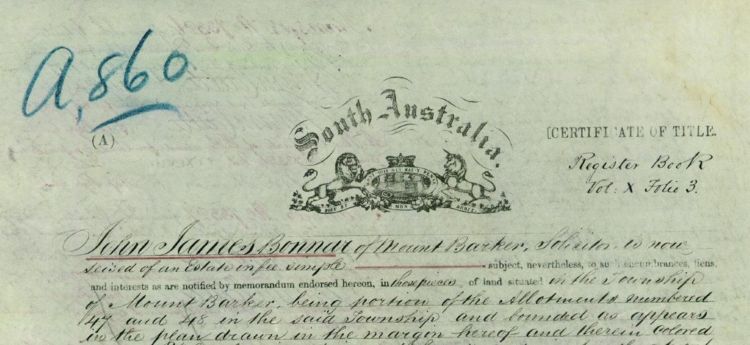
Excerpt from Certificate of Title Vol. 10 Folio 3 showing reference to Application no. 860
These changes to legislation replace the old way of accessing the packets, which was done through seeking permission from the land’s current owner - often an exhausting and unsuccessful task for researchers.
If you have any questions about accessing these records or would like to book an appointment to view an application packet at our Research Centre, contact us.
Further information about David's research can be found on his Facebook page (external site) (external site) (external site).