

What is decommissioning?
Decommissioning is the process of removing a business system or application (for example a database or a shared drive) from active use.
This can occur when a business system needs upgrading or replacing with new products that provide similar functionality, when the technology is performing poorly or when the technology is no longer supported.
Why does it matter?
Many agencies accumulate large amounts of information in systems, and some are not designed for long term use. Often these systems contain official records including long-term temporary or permanent value records.
The State Records Act 1997 (SR Act) requires agencies to appropriately manage and dispose of official records.
The SR Act defines an ‘official record’ as information, data and records, in any format (whether digital or hardcopy), where it is created or received through the conduct of government business.
Accordingly, systems should not be decommissioned without first considering whether the records held within might be needed in the future. Before decommissioning, records must be identified and either:
- Migrated to a new system
- Migrated to a new system with documented compromises
- Data extracted in an accessible and usable format and stored in another system for the retention period of the record e.g. Excel/PDF in an electronic document records management system
- Maintained ‘insitu / in place’ for the retention period of the record
Steps to decommissioning
When decommissioning occurs, there are some steps to take to manage the records within the system. The following workflow demonstrates the steps involved with decommissioning a system or an application:
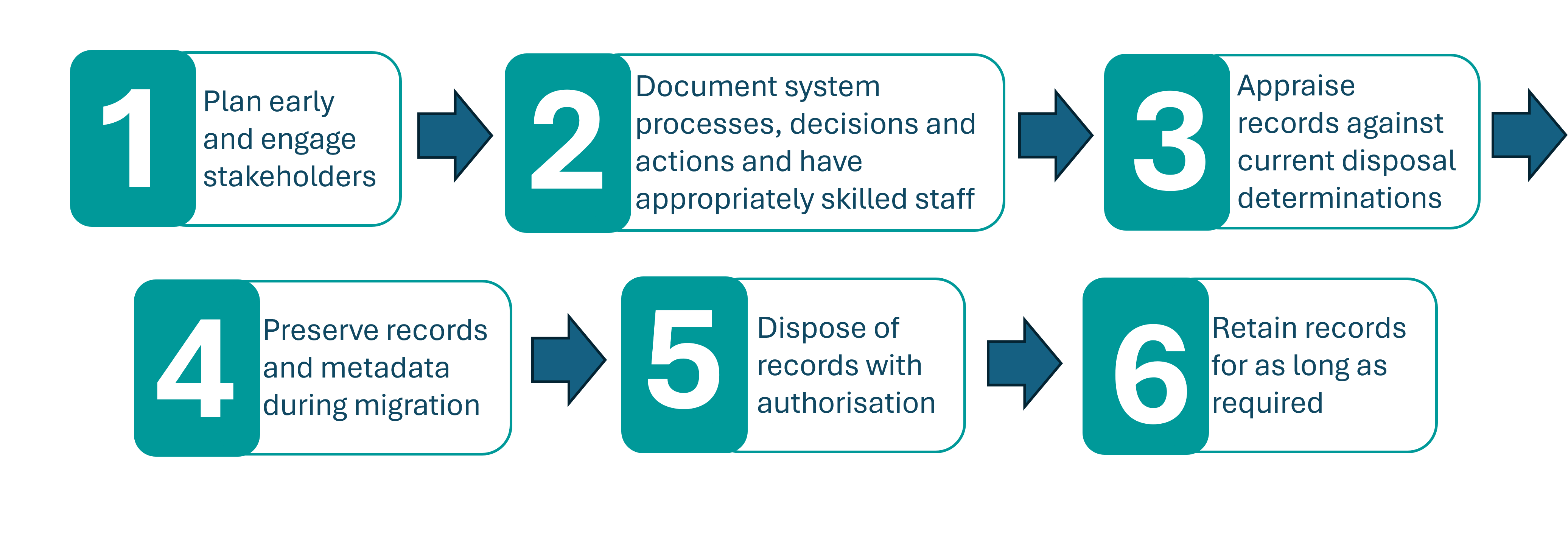
Planning and system analysis
Most business systems will contain official records that must be captured and retained, so it’s important to plan when decommissioning a system.
This should include analysis of the system to establish:
- what records the system holds
- what records can and can’t be accessed
- what records can and can’t be retrieved
- the value of records in the system (e.g. long-term temporary or permanent value)
- whether the records in the system are covered by a disposal determination
- the future use of any records
- what records have already been migrated to another system
- are there backups of the records in another system
- who is responsible for the records.
Responsibility for ensuring the records remain accessible for the retention period of the record usually sits with those that either:
- created the records,
- inherited the records through a machinery-of-government change,
- are responsible for the function or business activity the records document, or
- control the records.
Responsibility for the records may be different to the system owner. An agency may control records even when another entity operates or hosts the system. Control may exist when the agency has possession or custody of the records, or has the legal right or responsibility to access, manage or preserve them. For example, a service provider may operate a system that contains records belonging to multiple agencies.
Engaging with stakeholders
Engaging with stakeholders is essential to the success of the decommissioning process. Consultation with business owners, records managers and system administrators can identify risks to records and metadata in the system, highlight records management and legislative requirements, as well as the system functionality and limitations.
If the system contains records belonging to other agencies, involve them in the decommissioning process.
All decisions and actions supporting the system decommissioning (for example records migration and records disposal) should be documented so future users can understand the migration activities performed on records. This is particularly important for proving/maintaining the integrity and reliability of permanent value records.
Staff should be appropriately skilled to identify records in the system, address records and organisational requirements and to assess system functions and limitations. Staff will also need to know how to extract records/data from the system to be decommissioned and migrate records to a new system.
Once you have identified what records are contained within the system, you need to determine whether those records are covered by a disposal determination. The disposal determination will specify the minimum retention periods for the records and can help to identify which records are most important. Importantly, records within a system can have multiple retention periods.
Where a disposal determination identifies permanent and long-term temporary records, as State Records is currently unable to accept digital transfers, agencies are responsible for ensuing accessibility for the retention period of the record. This will need to be considered as part of any migration activities discussed below.
Records not covered by a disposal determination cannot be destroyed.
For further information on disposal, see State Records Disposal Standard and webpage on Disposal and Disposal Schedules.
When systems are decommissioned, you must ensure the records and associated metadata remain complete, retain their context and remain accessible and useable for their minimum required retention period.
Develop a migration plan to identify which records are in current use and those that aren’t, records that can remain in the decommissioned system (i.e. those that can’t be extracted due to existing system functionality) or be stored offline until their retention period ends.
The plan should consider:
- which records and metadata in the system need to be migrated to a new system
- how metadata will be mapped to the framework used in the new system
- how migration will be tested to ensure records and metadata have been transferred successfully.
All relevant stakeholders should be included in the development of the plan to inform decisions about which records are to be migrated and where they are migrated to.
If records have been migrated to another system, confirm the migration was successful before decommissioning the system and undertake quality assurance checks to confirm:
- all intended records have been successfully migrated to the new system
- record content is complete and unaltered
- metadata, attachments and contextual relationships remain intact and accurate
- records remain accessible and usable
- integrity checks have been carried out where appropriate.
Please refer to State Records Managing Digital Records in Systems Standard and Minimum Recordkeeping Metadata Requirements Standard for principles and requirements regarding migration.
Decommissioning a system provides an opportunity to conduct records disposal activities.
Section 23(1) of the SR Act does not allow agencies to dispose of official records except in accordance with a disposal determination approved by the State Records Council. Accordingly, agencies can only dispose of records covered by a current disposal determination.
A determination provides authorisation for records to be destroyed or transferred to non-government entities and comes in the form of either a disposal schedule or a transfer of ownership and custody schedule.
If records in the system have a current disposal determination and the retention period has expired, then provided the records are no longer needed for a business purpose, you should appropriately destroy the records.
Please refer to State Records Disposal Standard for the mandatory principles and requirements regarding disposal of government information. See also the State Records webpage on Disposal and Disposal Schedules.
Lost records
If an agency identifies that records have become lost or accidently/ inadvertently destroyed as part of the decommissioning process (for example due to system faults, obsolescence or failure), the agency must notify State Records Council of the loss of records.
Should this occur, please contact us for further instruction.
As mentioned above, if records have reached their retention periods, as outlined in a disposal determination, and are no longer required for a business purpose, they can be destroyed.
If a business purpose still exists, then the records need to be retained and appropriately managed or migrated to another system for as long as needed.
Permanent value records will need to be retained and maintained by agencies until a digital archive is established.
Records that cannot be extracted, for whatever reason, must remain in the system after it has been decommissioned, until the records can be lawfully disposed of. This is a risk for the agency to manage and the system will need to be actively managed for the required retention period of the records. The records will need to remain accessible, readable and useable for as long as the required retention period.
For ongoing management of these records in the decommissioned system, you may need to consider:
- Software needed to access and use records, noting records may need to be converted to different formats to remain accessible over time.
- Hardware and media the system is maintained on. Media may need to be refreshed, or a specific storage environment may be required.
- Whether service providers are required in the ongoing management of the system.
- Review of any contractual agreements.
Preservation advice is coming
State Records currently has preservation guidance under development.
The guidance establishes a set of Digital Record Preservation Principles, strategies and measures to help your agency with the preservation of digital official records.
For further advice, please contact us.