

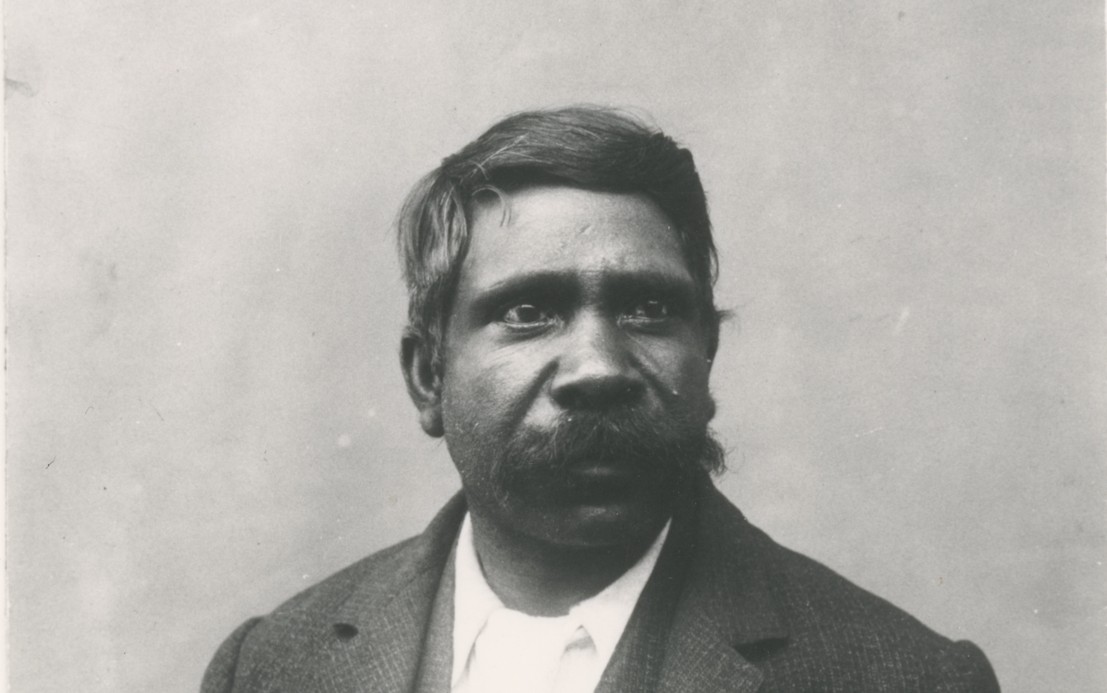
David Unaipon (Ngunaitponi), the Ngarrindjeri man on the $50 note, was an inventor, preacher, advocate, and the first published Aboriginal author.
Among his achievements was a patent for a sheep shearing device, whose design has been adopted by other manufacturers and heralded as an advance in the wool industry.
He chronicled the lives of Aboriginal peoples among many publications, including Legendary Tales of the Australian Aborigines.
- Aboriginal Access Team
- Finding your Aboriginal History
- Guides to Aboriginal History
- Aboriginal People in South Australia – 1900-1940 (external site) (external site)
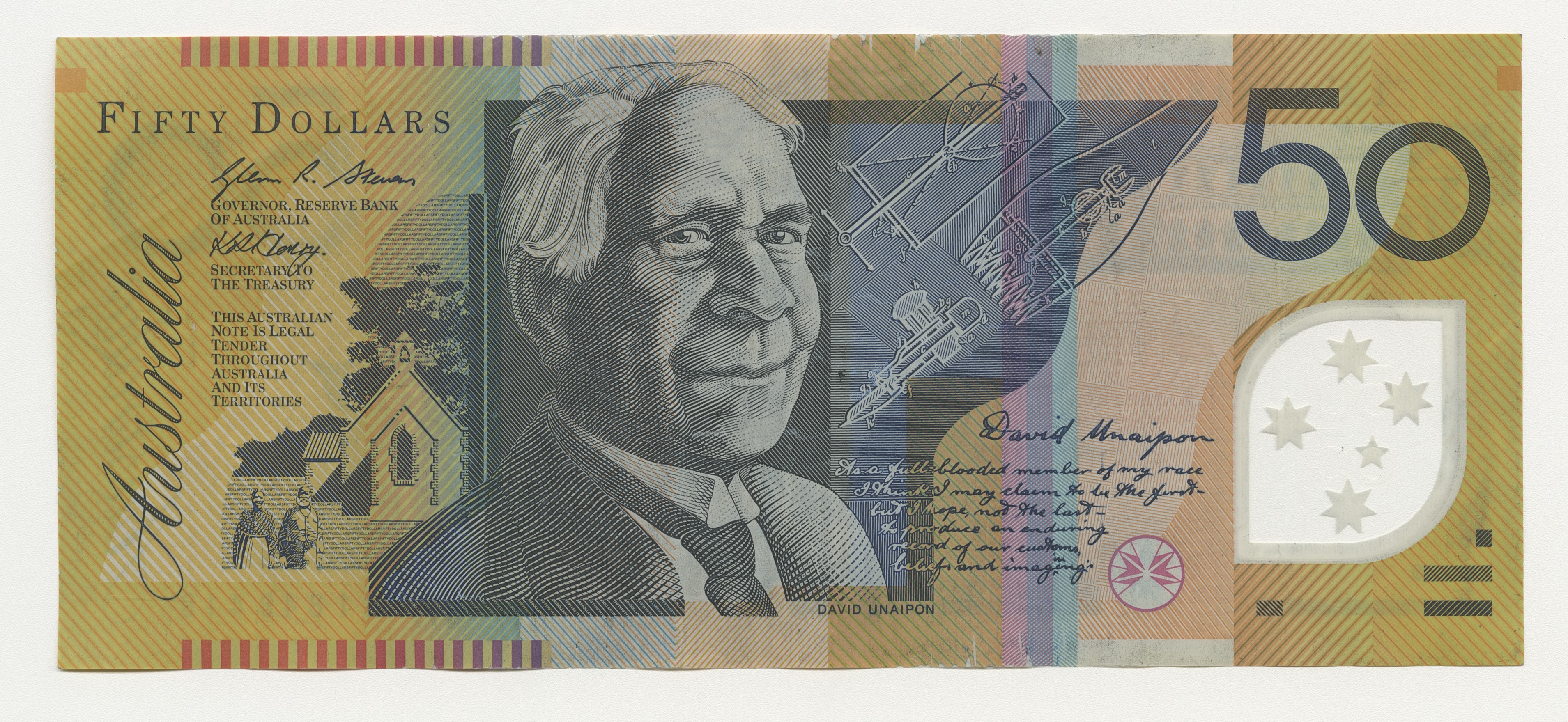
How Unaipon was selected for the $50 note
The decision to put Unaipon on the $50 note came shortly after the Eddie Mabo case (Mabo v Queensland, No 2) in 1992 when the High Court’s ruling effectively made the concept of terra nullius before colonisation invalid[1][2]. This coincided with the transition to polymer banknotes.
The Reserve Bank of Australia spoke with the Aboriginal and Torres Strait Islander Commission Board for advice on how to recognise the Mabo decision. The board suggested several names for the $50 note, including Unaipon’s[3].
Early years
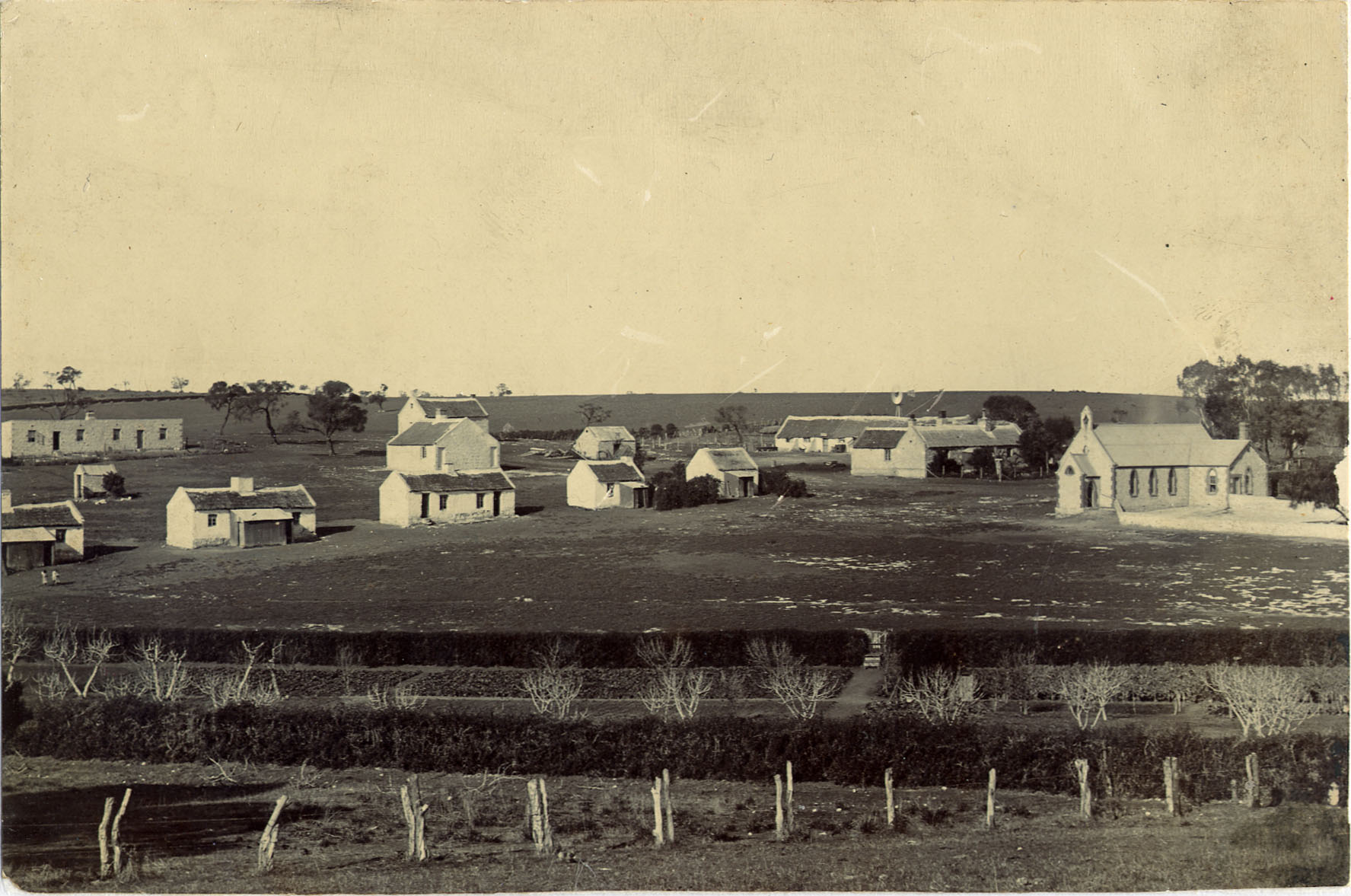
Unaipon was born at Point McLeay Mission (now Raukkan), on South Australia’s Lower Lakes on September 28, 1872. His parents were James Unaipon, the first Aboriginal man to have converted to Christianity in the area and a missionary, and James’s wife Nymbuldat.
His school register, kept in the State’s archive at Gepps Cross, Adelaide, shows he attended Point McLeay Mission School from 1885 to 1887, before leaving on September 1, 1887, to become a servant to CB Young of Kanmantoo.
A strong interest in science
Unaipon had a strong interest in perpetual motion, a concept where once a device started moving, it could keep on going forever without any external input or force[4]. Some of this was influenced by him reading texts about science in the Mission’s collection.
His first and only granted patent was for an “improved mechanical motion device”, an updated sheep shearing device. Submitted for approval in 1909, the device turned a rotary movement into a straight line one, and helped improve “problems with the mechanism seizing, difficulties in shearing fine merino wool, and dust and dirt spraying into shearers’ faces.[5]”
While the patent lapsed, the concept was copied by other manufacturers[6], and Unaipon is celebrated for his influence in the sheep shearing industry. The original patent is with the National Archives of Australia and can be seen in digital form here (external site) (external site).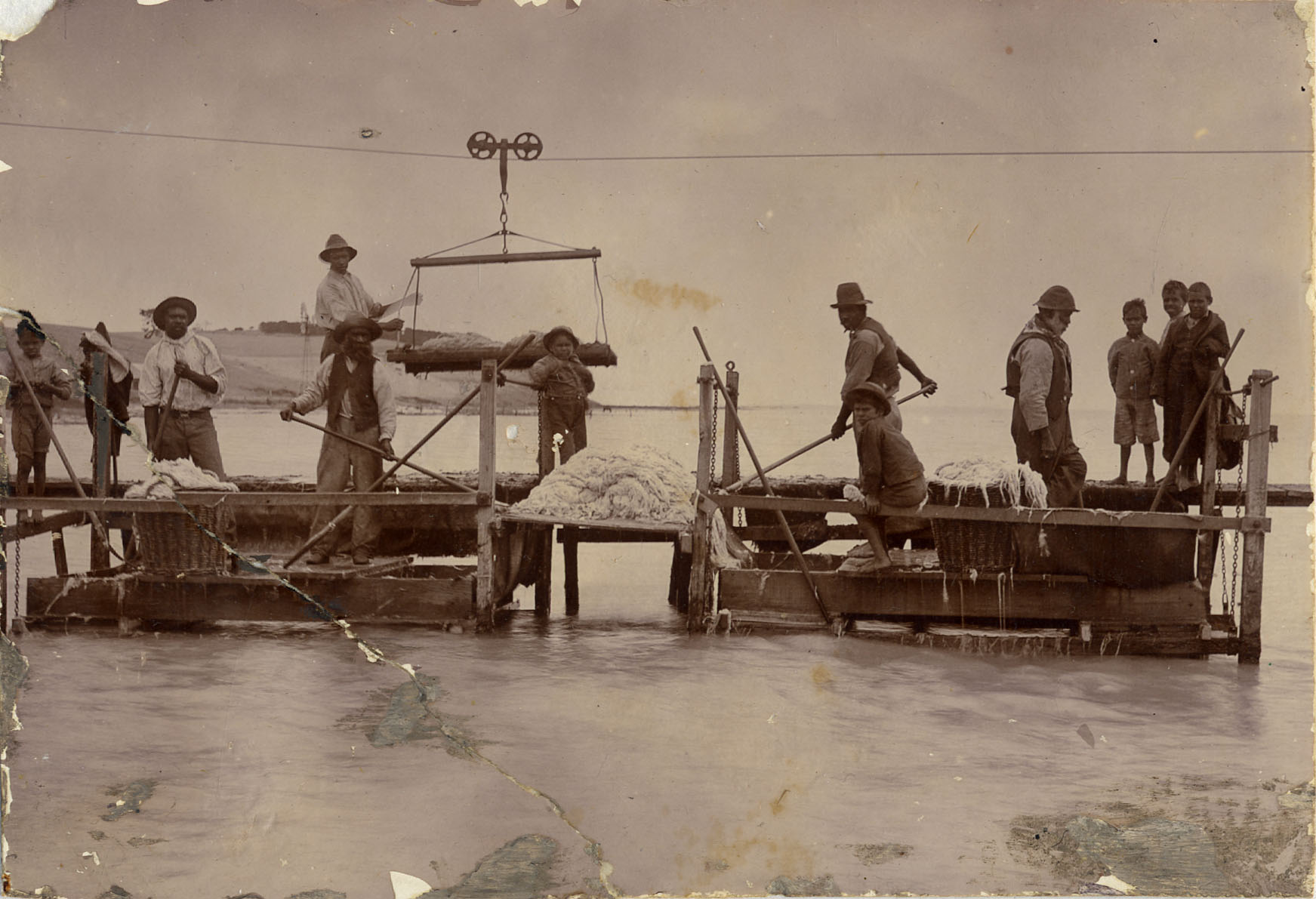
Advocacy for Aboriginal people
Unaipon was an advocate for Aboriginal peoples. Among his efforts were giving evidence to royal commissions in 1913 and 1926[1], supporting the Bleakley inquiry into Aboriginal people’s welfare in 1929[2], and in 1934 advocating for the Commonwealth government to take on Aboriginal affairs from the states and the South Australian Protector of Aborigines be replaced with an independent board[3].
Among the ways he was highly regarded is revealed in the State’s archive. In an Advisory Council of Aborigines file from 1925, there is a letter from John H Sexton to the Commissioner of Public Works seeking support for Unaipon to work at the Adelaide Museum (South Australian Museum) within the First Nations collection[4]. But ultimately this appointment never happened[5].
Christianity
Unaipon was a religious man, spreading the word of God in his travels across Australia, fuelled in part by his father’s influence. He returned to the Mission in 1890. The Raukkan Church, depicted in photos (external site) (external site) within the State’s archive, is featured on both the 1995 and 2018 editions of the $50 note.
The first Aboriginal author
With published content dating back to the 1920s, Unaipon is recognised as the first Aboriginal published author. He had received funds from both Adelaide University (University of Adelaide) and the Aborigines' Friends' Association to write content about Aboriginal peoples for various purposes.
Among his earliest publications is Legendary Tales of the Australian Aborigines, which captured the stories of Aboriginal peoples. When it was first published in 1930, it went by the title of Myths and Legends of the Australian Aboriginals and was credited to William Ramsay Smith, after rights to the manuscript were sold to him without Unaipon’s permission and plagiarised[6][7][8].
The original manuscript was found in the archives of the State Library of New South Wales in 1995[1]. Professors Stephen Muecke and Adam Shoemaker worked with Unaipon’s descendants to restore the original text, and it was republished under Unaipon’s name and his original title in 2001[2]. A copy of the book is in State Records’s reference material in the Research Centre at Gepps Cross, Adelaide.
Personal life
Unaipon married Katherine Carter (née Sumner), a Tangani woman, on January 4, 1902, and they had a son, Talmage de Witt, who incidentally also filed a patent.
Unaipon died on February 7, 1967, at Tailem Bend, aged 94.
Legacy
Recognition as an author has extended beyond his own writing; the David Unaipon Award, which commenced in 1988, is given by the University of Queensland Publishing and is the most prestigious Indigenous literary prize in Australia.
Unaipon will be immortalised as part of a series of statues in Adelaide memorialising prominent Aboriginal South Australians. Supported by the State Government and City of Adelaide, the first statue unveiled was of Yankunytjatjara woman Dr Lowitja O’Donoghue AC CBE DSG, the first Aboriginal woman to be appointed a Member of the Order of Australia, later elevated to Companion of the Order of Australia[3].

Records, photos, letters and other materials about Unaipon are on display at the State Records’ location at 115 Cavan Road, Gepps Cross until October 2026.
It follows a previous showing of the display at the GPO Exchange on 10 Franklin Street, Adelaide, during NAIDOC Week 2026.
Thanks to the State Records of South Australia Aboriginal Access Team, Reserve Bank of Australia, National Archives Australia, and the Australian Wool Innovation Limited for their support with research and content for this article and exhibition.
For more information about State Records’ services for Aboriginal peoples, can be found here (external site) (external site).
Resources
Finding your Aboriginal History
Footnotes
[1] First Nations People and Australian Banknotes, Reserve Bank of Australia Museum, accessed June 6, 2025, https://museum.rba.gov.au/exhibitions/first-nations-peoples-and-australian-banknotes/innovation/
[2] Eddie Koiki Mabo and the Mabo Case, National Archives of Australia, accessed June 15, 2026, https://www.naa.gov.au/explore-collection/first-australians/eddie-koiki-mabo-and-mabo-case
[3] First Nations People and Australian Banknotes, Reserve Bank of Australia Museum, accessed June 6, 2025, https://museum.rba.gov.au/exhibitions/first-nations-peoples-and-australian-banknotes/innovation/
[4] Perpetual motion, Adam Augustyn (external site) (external site), Britannica, accessed June 16, 2026, https://www.britannica.com/science/conservation-of-energy
[5] David Unaipon, Inventor, pp5, Kym Kropinyeri & Kathy Bowrey, Australian Historical Studies, 2023, Routledge Taylor & Francis Group, https://doi.org/10.1080/1031461X.2023.2189276
[6] Offcuts: Sheep Have Currency, Quality Wool. Accessed June 15, 2026, (external site) (external site)https://qualitywool.com/news/2021/11/offcuts-sheep-have-currency/ (external site) (external site)
[7] State Library of South Australia, guides.slsa.sa.gov.au/Unaipon Accessed June 17, 2026
[8] David Unaipon, Reserve Bank of Australia, banknotes.rba.gov.au/australias-banknotes/people-on-the-banknotes/david-unaipon/ Accessed June 17, 2026
[9] State Library of South Australia, guides.slsa.sa.gov.au/Unaipon Accessed June 9, 2026
[10] GRG52/10/1/18
[11] David Unaipon, Inventor, pp15, Kym Kropinyeri & Kathy Bowrey, Australian Historical Studies, 2023, Routledge Taylor & Francis Group, https://doi.org/10.1080/1031461X.2023.2189276
[12] David Unaipon: Writer and Trailblazer, published September 7, 2022, accessed June 5, 2026, www.indigenous.gov.au/stories/david-unaipon-writer-and-trailblazer
[13] Legendary Tales of the Australian Aborigines, Melbourne University Publishing, accessed June 6, 2026, David Unaipon (external site) (external site), Stephen Muecke (external site) (external site), and Adam Shoemaker (external site) (external site)
[14] First Nations People and Australian Banknotes, Reserve Bank of Australia Museum, accessed June 6, 2025, https://museum.rba.gov.au/exhibitions/first-nations-peoples-and-australian-banknotes/innovation/ (external site) (external site)
[15] David Unaipon: Writer and Trailblazer, published September 7, 2022, accessed June 5, 2026, www.indigenous.gov.au/stories/david-unaipon-writer-and-trailblazer
[16] Legendary Tales of the Australian Aborigines, Melbourne University Publishing, accessed June 6, 2026, David Unaipon (external site) (external site), Stephen Muecke (external site) (external site), and Adam Shoemaker (external site) (external site)
[17] First trailblazing Aboriginal leader immortalised, Premier of South Australia’s office, June 2, 2026, premier.sa.gov.au/media-releases/news-items/first-trailblazing-aboriginal-leader-immortalised